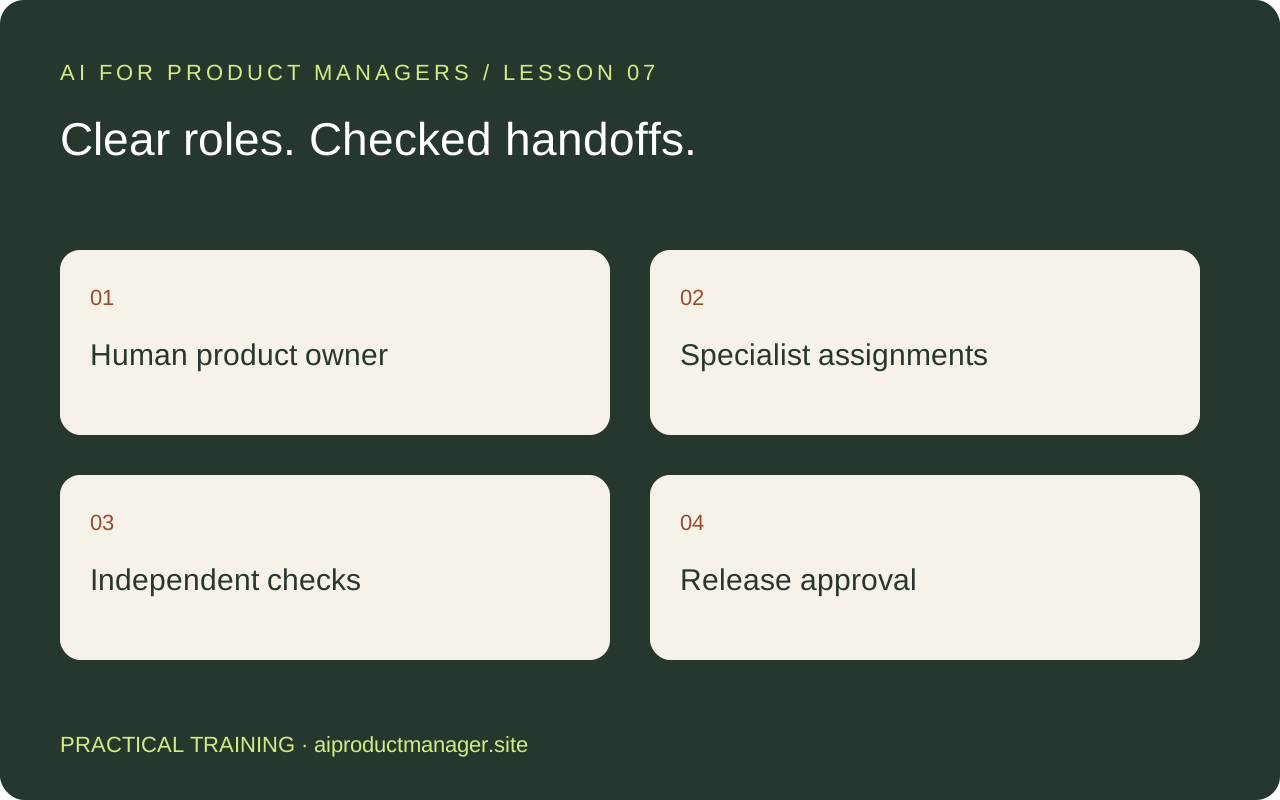
Start with three roles, then expand
Begin with a product lead, a builder and a reviewer. These can initially be separate conversations with explicit briefs and manual handoffs. A role prompt alone does not create an autonomous agent: automation requires a tool-enabled environment, permissions, execution controls and logs. Add specialized roles only when the workload justifies them.
Your job as product owner is to choose the problem, approve tradeoffs and remain accountable for customer outcomes. Agents can prepare work and execute bounded tasks. They do not replace real customer evidence or professional review.
Give each role a concrete contract
| Role | Input | Output | Human review |
|---|---|---|---|
| Research partner | Approved notes and questions | Evidence table and unknowns | Researcher verifies source attribution |
| Product lead | Evidence and strategy | Scope, PRD and acceptance criteria | PM approves problem and priorities |
| Design partner | Approved journey and system | Prototype with errors and recovery | Designer checks usability and access |
| Development partner | Approved spec and repository | Small change with checks and documentation | Engineer reviews correctness and security |
| QA partner | Acceptance criteria and changed build | Reproduction steps and pass/fail evidence | Owner resolves failures before release |
| Analytics partner | Tracking plan and permitted data | Data-quality report and outcome readout | Analyst verifies calculations and inference |
Step 1: create a shared project packet
Keep a product brief, source index, decision log, design reference, acceptance criteria and task board in a controlled workspace. Give every artifact a version and owner. Mark assumptions explicitly. Use synthetic data for development, and provide only the minimum access each role needs.
Step 2: establish the handoff format
Every handoff should name the task, inputs and versions, changed artifacts, evidence, checks actually run, known failures and next owner. “Done” without a reviewable artifact is not completion. If an agent cannot find an input or reproduce a check, it should return a blocker rather than fill the gap with a guess.
Act as the [role] for [task]. Use only [approved inputs and versions]. Deliver [artifact] that meets [acceptance criteria]. You may use [tools] within [scope and budget]. Do not change [protected areas]. Return artifact links, evidence, checks actually run, unresolved issues and the next handoff. Stop for missing evidence, conflicting requirements or actions outside your authorization. Do not claim a test passed unless you ran it and retained the result.
Step 3: coordinate dependencies
Validate the problem before approving a build. Agree on a core journey before implementation. Independent research questions or test preparation can proceed together, but two agents should not edit the same files blindly. Assign clear file ownership or isolated branches. Designate one integration owner to resolve conflicts and run combined checks.
Step 4: separate building from checking
Ask the reviewer to work from acceptance criteria and inspect the actual artifact, not merely the builder's summary. Require functional checks, keyboard and mobile review, failure-state handling and appropriate security review. Two AI agents can share the same blind spot; retain a human review gate for important decisions and release.
Step 5: run a small capstone
Build one fictional appointment-booking journey. The research role lists evidence gaps; the PM defines a small scope; design produces a testable flow; development implements it in a nonproduction environment; QA checks success and failure paths; analytics specifies events. The owner decides whether the evidence supports a limited pilot.
Keep deployment credentials and production data out of a teaching exercise. In a real project, document who authorizes external actions, spending and release. Include rollback, monitoring and incident ownership before launch.
Measure whether the team helps
Track total time including review, rework, escaped defects, cost per completed task and customer outcomes. Compare against a simpler workflow. If coordination costs exceed the benefit, reduce the number of roles. The useful team is the smallest one that produces reliable, reviewable work.
Practice assignment
Spend 90 minutes creating role briefs, one shared context packet and a sample handoff. Run the capstone in stages as additional practice. Finish with a decision log and a release checklist that records evidence rather than unchecked boxes.