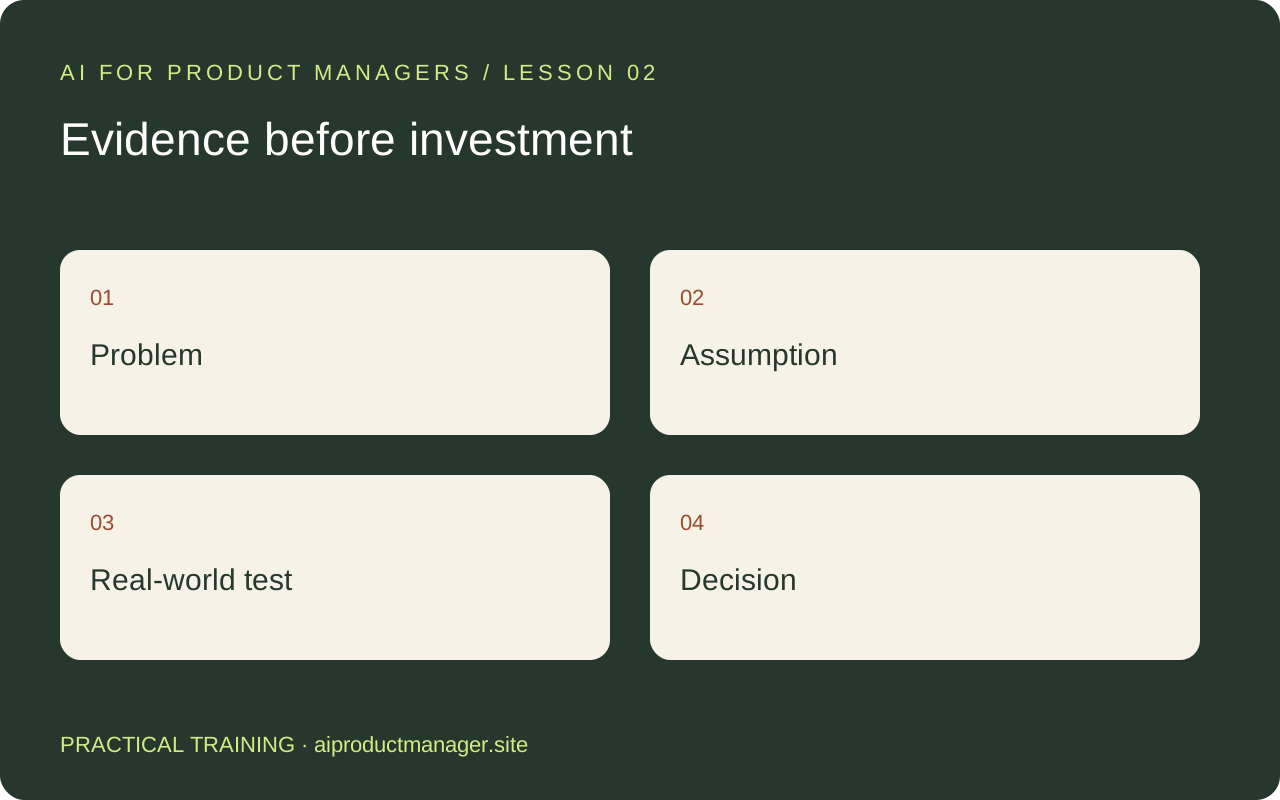
Define the decision, not the pitch
AI can help you structure uncertainty and prepare research. It cannot validate demand by agreeing with your idea. The goal of this lab is to decide whether one audience has a problem worth solving, and which evidence you need next.
For a fictional example, imagine a booking assistant for independent tutors. “Everyone needs scheduling” is too broad. A sharper hypothesis is that tutors who teach across multiple locations repeatedly lose time resolving availability conflicts. This is an illustrative hypothesis, not a market finding.
Step 1: map the riskiest assumptions
List assumptions about the problem, frequency, existing alternatives, willingness to change, willingness to pay and your ability to reach customers. Mark each as observed, inferred or unknown. Ask AI to challenge the assumption with the least evidence and the highest cost if wrong.
Step 2: prepare neutral interviews
Recruit actual people in the target group. Start with a small exploratory batch and expand when important segments or contradictions remain. Ask about a recent incident, the current workaround, time or money spent, and who makes the buying decision. Avoid “Would you use my amazing AI assistant?”
Create a neutral interview guide for [audience] about [problem]. Ask about the last real occurrence, current workarounds, consequences and buying process. Do not introduce our proposed solution until after problem exploration. Explain what evidence would challenge our hypothesis. Do not simulate participants or invent responses.
Step 3: organize evidence with traceability
Use permitted notes with participant IDs and timestamps. Ask AI to group recurring problems while keeping original observations attached. Separate direct quotes from summaries. Count participants rather than repeated mentions from one person. Preserve disagreements; a neat theme can hide a segment with completely different needs.
Step 4: choose a behavioral test
Pick an honest concierge pilot, prototype task, or landing page with a clear description of availability. Measure a meaningful action such as completing a trial task or agreeing to a pilot conversation. Email signups show interest, not retention or willingness to pay. Do not collect money for an unavailable product without clear terms and a fulfillment plan.
Write the pass, revise and stop conditions before collecting results. Set them from the economics and learning goal of your project rather than borrowing an arbitrary conversion benchmark.
Step 5: make the call
| Decision | Evidence to explain | Next action |
|---|---|---|
| Continue | Repeated problem plus meaningful behavior | Test the next uncertain assumption |
| Change | Problem exists but segment or solution is wrong | Revise the hypothesis and test again |
| Stop | Weak problem, strong alternatives or poor economics | Record learning and release capacity |
Practice assignment
Spend 45 minutes creating a validation brief; schedule real research separately. Your output should name one audience, one problem, three major unknowns, an interview guide, a behavioral test and a decision date. Have another person identify any claim that lacks evidence. Complete the linked canvas before investing in development.