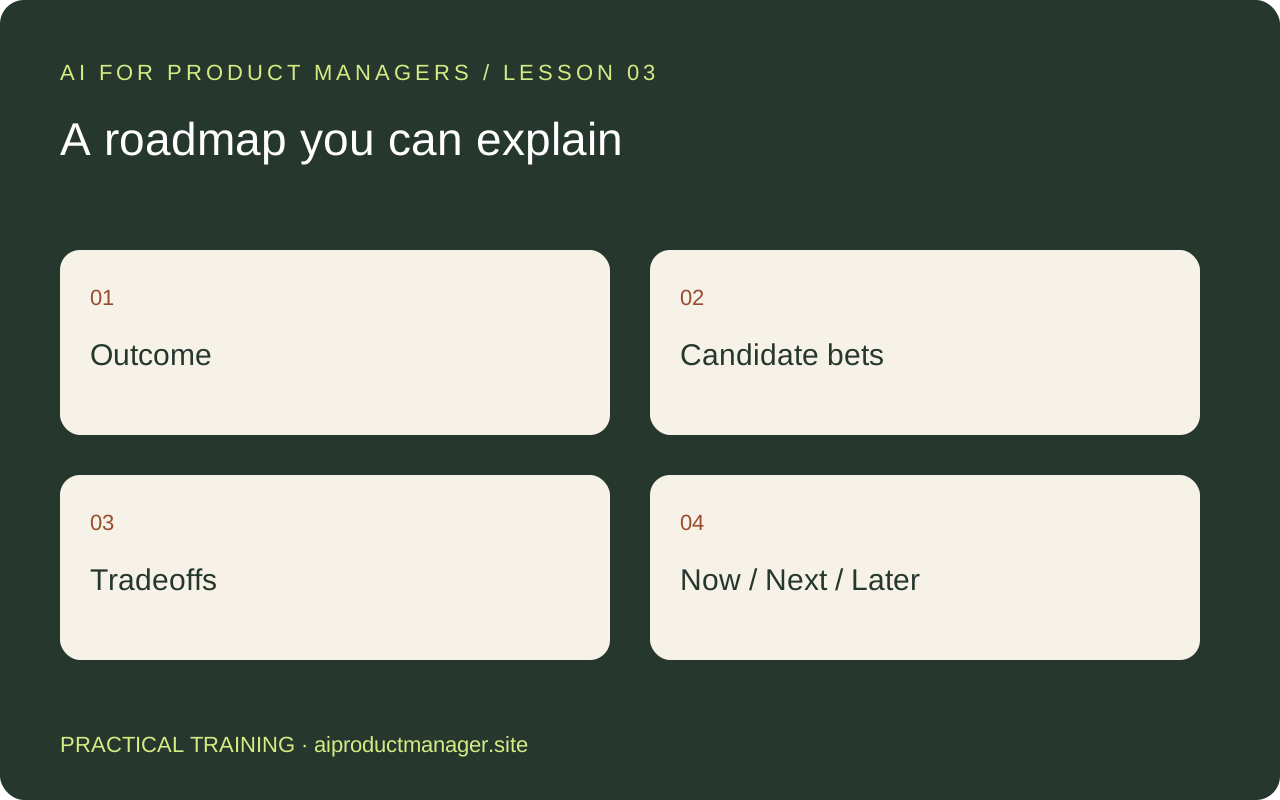
Begin with an outcome and a baseline
A roadmap communicates choices under uncertainty. Give AI your strategy, target customer, baseline metrics, current commitments, team constraints and research evidence. If a baseline is unknown, keep it unknown. Do not let a model manufacture confidence scores or delivery dates.
In our fictional booking product, the outcome could be more eligible customers completing their first booking. A calendar redesign is one possible intervention, not the outcome itself. Other explanations might include unsuitable availability, confusing pricing or low-intent traffic.
Step 1: translate requests into problems
Create an evidence table with request, underlying problem, affected audience, source and possible outcome. Keep stakeholder requests distinguishable from customer observations. Ask AI to identify duplicated proposals and contradictory requirements, then review those groupings yourself.
Step 2: compare a small set of bets
Include the option to do nothing and a low-cost operational improvement. Estimate impact and effort with the people who understand the system. Use ranges when uncertain. If using RICE, define reach period, impact scale, confidence evidence and effort units consistently. A generated numerical score is not customer evidence.
Using these approved strategy and evidence notes, propose no more than five product bets. For each include the customer problem, intended outcome, source IDs, uncertainty, dependencies and smallest learning milestone. Include a no-build option. Do not invent estimates. List questions for engineering and design wherever effort or feasibility is unknown.
Step 3: stress-test the ranking
Ask what changes if expected impact is half as large, effort doubles, or a dependency slips. Identify bets whose rank depends on optimistic assumptions. Discuss the tradeoffs with engineering, design, customer-facing teams and the accountable product owner before committing capacity.
Step 4: publish a readable roadmap
| Horizon | What belongs here | What to communicate |
|---|---|---|
| Now | Agreed work with owners and capacity | Outcome, scope and next learning checkpoint |
| Next | Promising bets awaiting evidence or dependencies | Why it matters and what must become true |
| Later | Options worth revisiting | Trigger for review, not an implied delivery promise |
Separate firm external commitments from this exploratory roadmap. Confirm dates with delivery owners. Document what you are deliberately deferring so stakeholders can see the cost of adding new work.
Step 5: keep it alive
At each review, compare new evidence with the original assumptions. Ask AI to draft a change log that links changes to evidence. A human approves any changes to scope, owners or commitments. Maintain a visible decision log so the team does not relitigate the same tradeoff every week.
Practice assignment
In 60 minutes, turn ten messy requests into three outcome-based bets. Produce a Now / Next / Later view, a rejected-options note and a decision update for stakeholders. Pass the exercise when each bet has an owner, evidence, uncertainty and a measurable learning milestone—not merely a feature title.