
A product manager asks for a prototype on Monday morning. By lunch, the team has three versions. The hard question is now which version is worth testing, what evidence would justify shipping it, and whether anyone has time to review the implementation. Faster creation changes the economics of exploration. It does not choose the right product.
Spotify’s June 2026 account of AI-assisted development captures this shift. The company reports a 76% increase in pull-request frequency, more than 99% weekly AI-tool adoption among engineers, and 94% saying the tools improved productivity. Those figures describe one organization’s experience. PR frequency, perceived productivity and customer outcomes are different measures.
The interesting change is where work waits
Spotify’s background coding agent, Honk, operates within infrastructure the company built over years: component ownership and documentation in Backstage, fleet-wide orchestration in Fleetshift, and standardized engineering practices. Product teams should pay attention to that surrounding system. An agent can implement a requirement quickly while remaining completely dependent on the quality of the requirement.
Imagine a team that can implement ten small changes a week but approve only four. Making implementation twice as fast does not automatically increase accepted delivery. It can increase the review backlog. This is an illustrative capacity example, not a Spotify measurement. A better response is to make incoming work clearer and limit how much work reaches each overloaded stage.
The PM’s job becomes more explicit: choose which uncertainty deserves attention; distinguish an experiment from a commitment; ensure someone can assess the result; and stop work that no longer serves the goal.
1. Start with a question that changes a decision
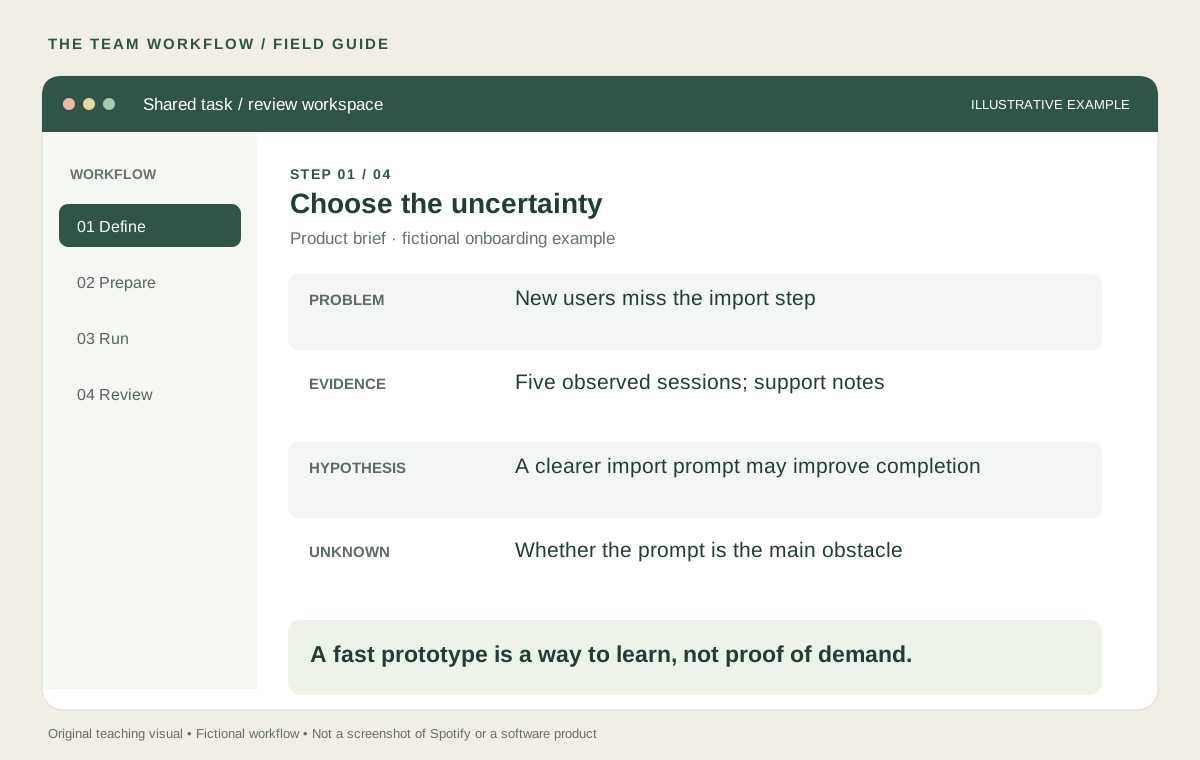
In our fictional onboarding example, new users struggle to import their first file. The team has five observed sessions and support notes, but does not yet know whether the main problem is discoverability, confusing terminology or an unsupported file format. Asking an agent to redesign onboarding would hide that uncertainty under a larger interface.
Instead, ask for a prototype that makes the existing import action easier to find. Keep the dataset and permissions unchanged. The decision is whether this direction deserves further testing. Ask participants to attempt the task without coaching, observe where they hesitate, and record both successful and failed attempts.
Tip: require the brief to say, “After this work, we will decide whether to…” If nobody can finish that sentence, the task may produce activity without resolving anything.
2. Write a decision-ready brief
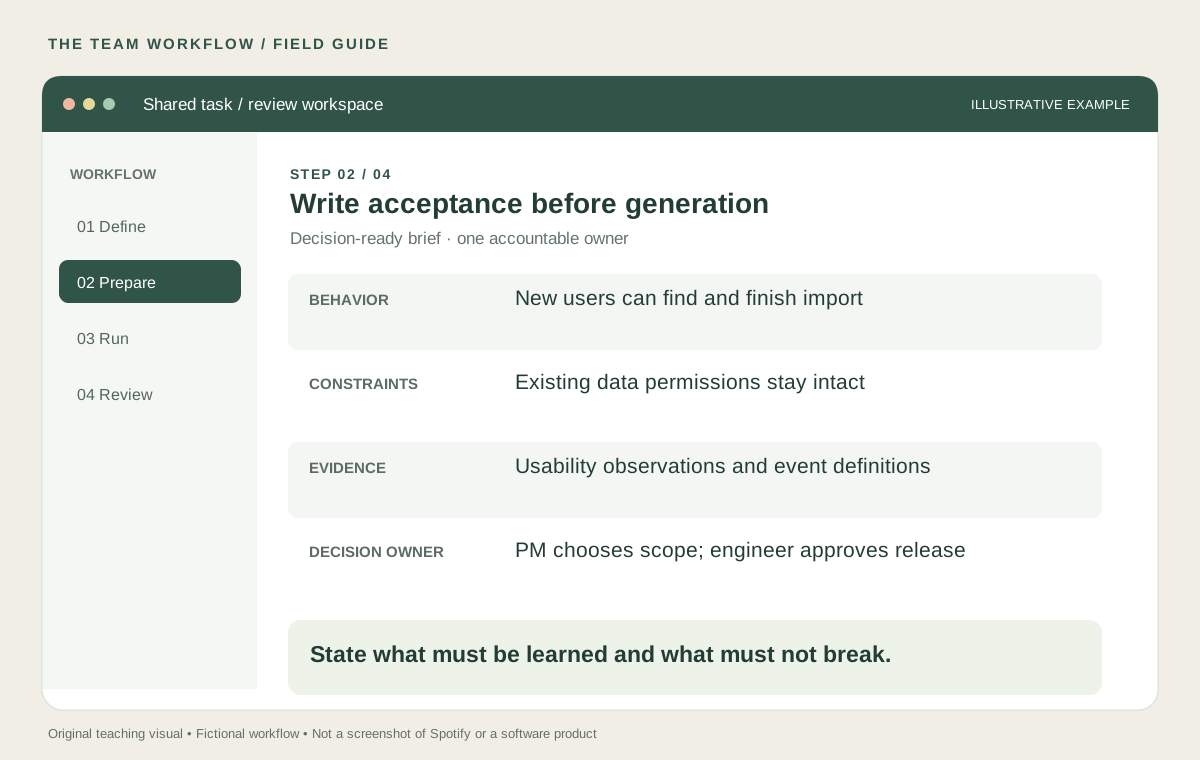
A useful brief contains the user problem, current evidence, proposed behavior, constraints, acceptance checks, open questions and decision owner. Mark which statements came from research and which are hypotheses. Give the agent relevant examples from the current product instead of asking it to infer your design system.
Translate adjectives into observable checks. “Make importing seamless” is difficult to verify. “A new user can locate the import action, select an allowed file, understand an invalid-file error and see a truthful completion state” is much more actionable. For analytics, name the event and denominator before release.
Split ownership. The PM is accountable for the problem and scope; engineering owns technical acceptance; design reviews the user journey; the release owner authorizes exposure. People may hold several roles on a small team, but every decision still needs a name.
3. Keep prototype, review and release as separate states
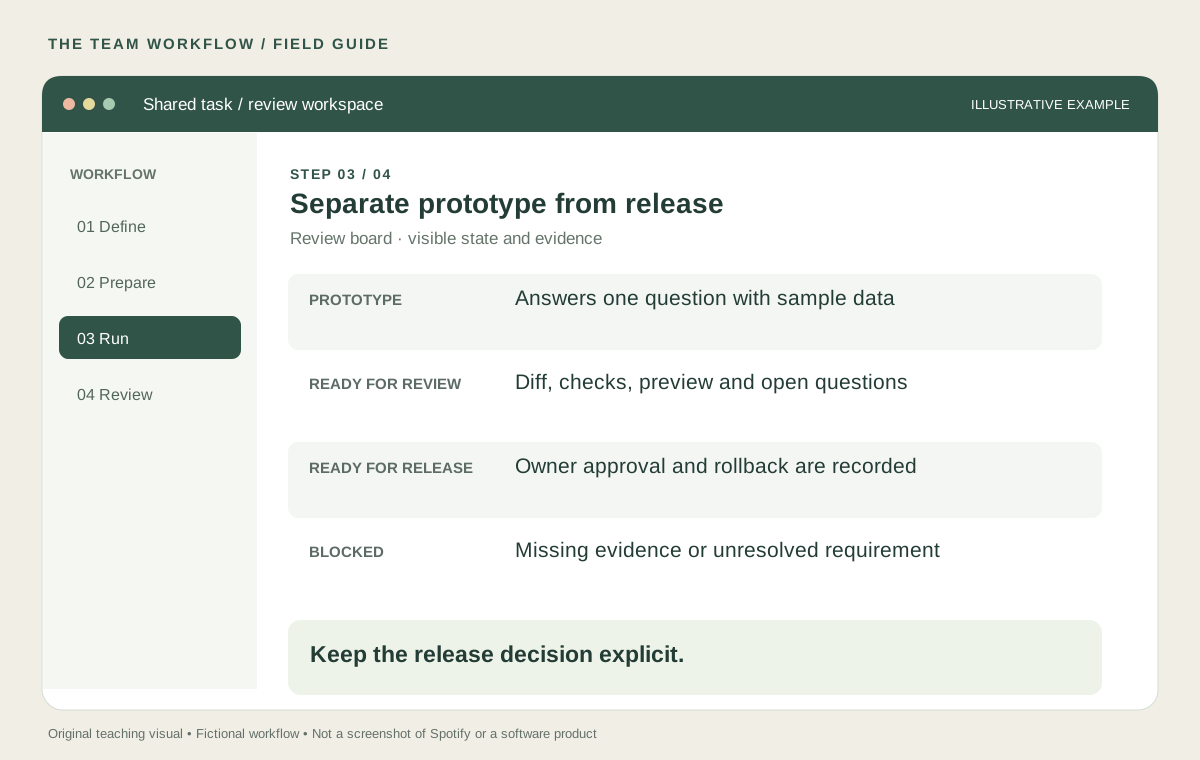
A prototype can be useful with sample data and temporary wiring. A production release needs appropriate checks, permissions, observability, support readiness and a rollback route. Put these differences in the workflow so a compelling demo does not silently become a release approval.
Use a shared review packet: intended behavior, before-and-after preview, exact checks performed, known limitations and the decision needed. Ask agents to return unresolved questions alongside the work. “Not tested” is valuable information; do not let a polished summary turn it into “passed.”
Reserve reviewer capacity before starting more jobs. Set a small work-in-progress limit—for example, two items waiting on one reviewer—and change it based on actual flow. This is a proposed operating rule, not a universal optimum. Keep one task owner even when several people contribute context to the same agent session.
4. Measure the customer and the delivery system
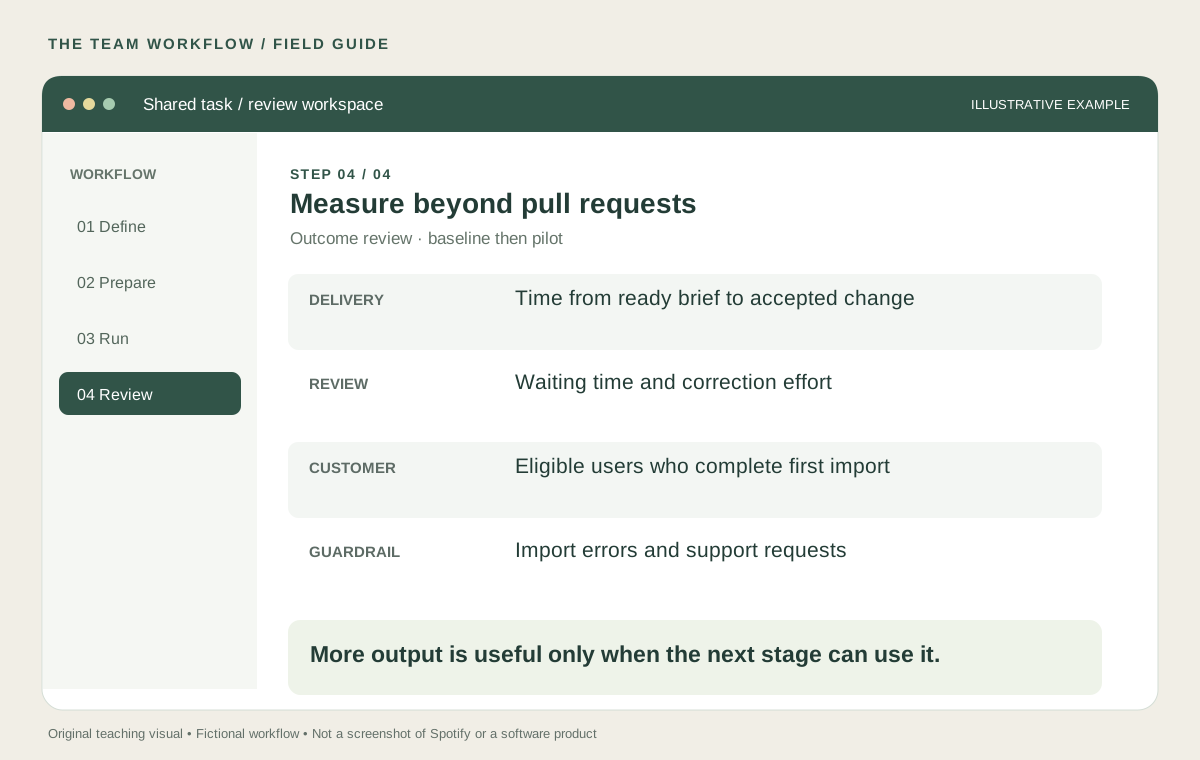
Track elapsed time from a ready brief to an accepted change, review waiting time, human correction effort and escaped defects. Then separately measure whether the change helped the customer. For the import example, count eligible new users who finish a valid first import and report the denominator and observation window.
Watch guardrails such as import errors, duplicate records and support requests. A clearer button that sends more users into a broken workflow is not a successful improvement. If possible, use a controlled rollout with comparable groups. Otherwise, report before-and-after changes as observational and record other changes that could explain them.
Do not turn PRs per engineer into an individual performance leaderboard. A small, careful change may remove more friction than a large pile of generated code. Review the work as a team and investigate where it waits.
A two-week product-team pilot
- Days 1–2: choose a repeated, reversible task and review comparable past work. Agree the customer outcome and quality boundaries.
- Days 3–4: create the brief template, reference examples, checks and ownership map. Run one task together.
- Days 5–8: complete a small batch. Keep failed attempts in the log and review the actual diffs and behaviors.
- Days 9–10: compare total effort and accepted outcomes. Continue, narrow the workflow, or stop. Keep unresolved customer effects visible if the measurement window is too short.
A brief pilot can show that a process is usable and suggest where it saves effort. It cannot settle long-term maintainability or customer retention. Schedule the appropriate later review as part of the release plan.
A prompt for the PM’s review
Review this brief before implementation.
Separate observations, assumptions and proposed decisions.
List ambiguities that could change the user-visible behavior.
Identify the smallest prototype that answers our question.
Write observable acceptance checks and name missing owners.
Do not invent research, metrics or a release approval.
Return: ready to start / revise / blocked, with reasons.
The practical lesson from Spotify is to make product judgment easier to exercise at higher speed. Better context, smaller decisions and visible evidence give a team a way to benefit from rapid coding without allowing the volume of work to decide its priorities.
Source
Spotify Engineering, Coding Is No Longer the Constraint, June 3, 2026. The operating model, fictional onboarding scenario and pilot plan above are our application of the case, not reported Spotify procedures.